Most people walk past their water meter every single day and never give it a second thought. Fair enough. It just sits there in its little concrete pit doing its thing. But that meter is actually one of the most useful tools you have for keeping your water bills under control and catching a leak before it turns into something expensive. This is a proper step by step walkthrough so you can do this yourself, today, with no special tools and no plumbing knowledge required. I will also flag the spots where people go wrong so you do not end up chasing your tail.
Step One. Find Your Water Meter
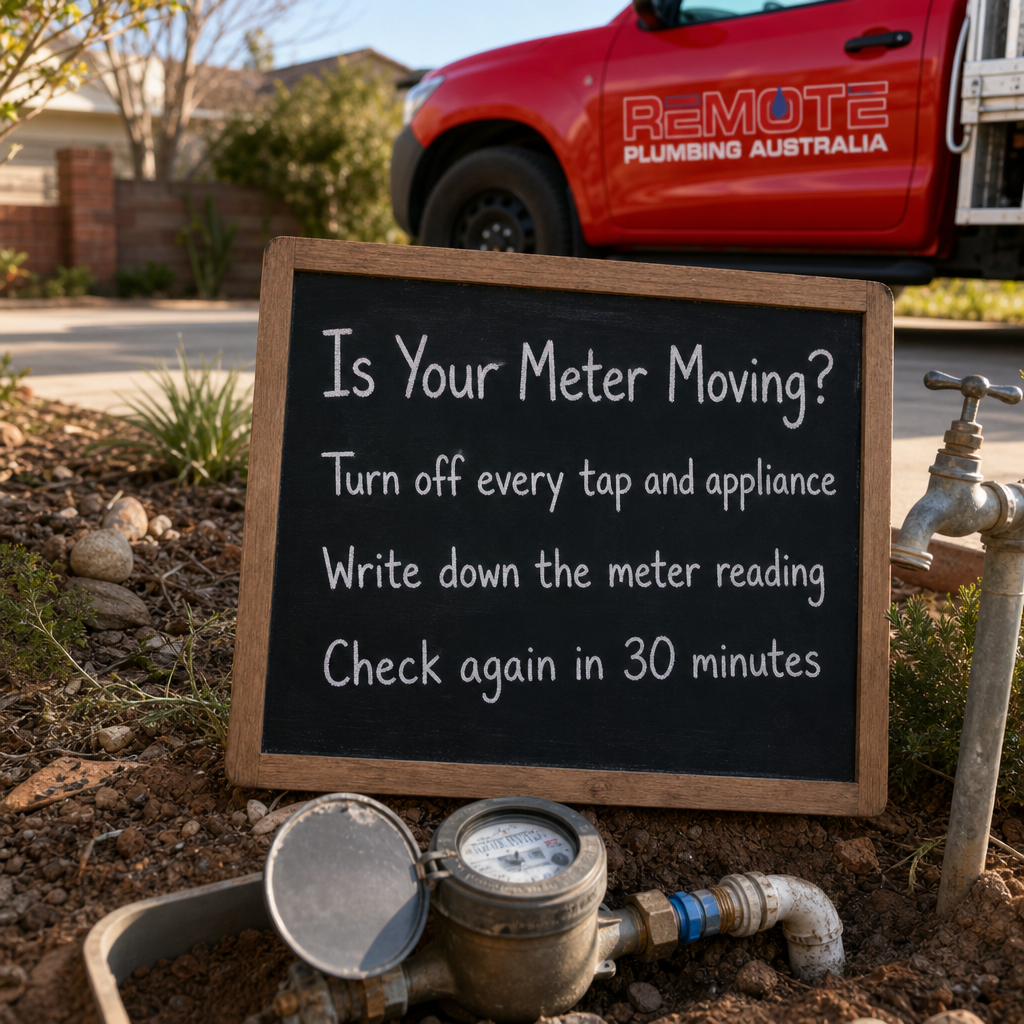
This sounds obvious but it trips people up more than you would expect. In most Mildura properties the meter lives in a small concrete or plastic box set into the ground near the front boundary of the block. It is usually close to the footpath or the driveway. You might have a lid you need to lift. Give it a gentle lift with your fingers or the toe of your boot and set it aside carefully.
If you genuinely cannot locate the meter, check your last water bill. Sun Land (now Lower Murray Water) bills will often show the meter number and sometimes the general location. A quick call to your water authority can point you in the right direction too.
One thing to watch. lift the lid slowly. Spiders love those dark little boxes. A big huntsman in your face at seven in the morning is a fine way to ruin a day.
Step Two. Understand What You Are Looking At
Most residential water meters in the Sunraysia region are either a dial type or a digital LCD display type. The principle is the same on both. You are reading the total volume of water that has passed through the meter since it was installed, measured in kilolitres. One kilolitre is one thousand litres, which is worth knowing when you are looking at your bill later.
On a dial meter you will see a row of numbers with a red or black pointer hand, similar to an electricity meter. The main black digits on the left are kilolitres. The smaller red digits or the red pointer section on the right are the decimal portion, litres down to fractions of a litre. Write down the full number including the red section.
On a digital meter you will see the reading displayed directly. Some older digital meters cycle through different displays so give it a moment if the screen looks blank or is showing something unexpected.
The trap here is ignoring the red digits. Those small numbers matter when you are testing for a leak. Do not just read the black section and call it done.
Step Three. Run the Leak Test
This is the part that actually tells you something useful. Here is how to do it properly.
- Turn off every tap, appliance and water using thing in the house. That includes the dishwasher, washing machine, evaporative cooler, ice maker if you have one, and any irrigation or dripper systems outside. Everything off.
- Take a clear photo of the meter reading or write down every single digit you can see including the red section. Note the time.
- Now leave the property alone for at least thirty minutes. An hour is better. Do not flush a toilet, do not wash your hands, do not run anything.
- Go back and read the meter again. Compare it to your first reading.
If the reading has not moved at all, that is a good sign. You likely do not have an active leak on the property side of the meter.
If the reading has moved, even slightly, water is going somewhere. It could be a dripping tap you forgot about, a toilet that is running internally, an irrigation valve that did not close fully, or an underground pipe that is leaking where you cannot see it.
The big trap people fall into here is forgetting to turn off the evaporative cooler. In Mildura in September that thing can still be running and it will use a steady trickle of water even when the house feels still. Always double check that one.
Step Four. Narrow Down Where the Leak Is Coming From
If you have confirmed the meter is moving with everything turned off, the next step is working out whether the leak is inside the house or outside in the underground supply line.
Most properties have a stop tap or isolation valve where the pipe enters the house, usually at the wall where the meter pipe comes in under the slab or through the wall. If you turn that valve off and the meter stops moving, the leak is inside the house. If the meter keeps moving even with that valve shut, the leak is somewhere in the pipe between the meter and the house.
Inside leaks are usually toilets. A toilet that is constantly running water into the pan is the single most common hidden water waster I come across on Mildura properties. You can sometimes hear it if the house is quiet. Drop a small amount of food colouring into the cistern, do not flush, and wait fifteen minutes. If colour appears in the pan without flushing, the cistern outlet is not sealing properly.
Underground leaks between the meter and the house are harder to see. Signs to look for include a patch of ground that stays wet or green when everything else is dry, a section of path or driveway that has developed a soft spot or a crack that was not there before, or a water bill that has jumped for no obvious reason. Those situations need a plumber. Underground leak detection is not something you can DIY effectively and an undetected underground leak can undermine your slab over time, which is a much bigger problem than the water bill.
Step Five. Know When to Call It In
The meter test and the basic checks above are genuinely useful things any homeowner can do. But there is a clear line between checking and fixing. If your test shows the meter is moving and you cannot identify an obvious culprit like a running toilet or a tap you missed, that is the point to call a licensed plumber.
The most common situation I see is a homeowner who has been watching a slightly elevated water bill for months, assumes it must be their usage, and eventually calls when the bill has doubled. By that point a slow underground leak has been running for a long time. Catching it early with a simple meter test could have saved a fair bit of water and money.
Water authorities in Victoria do sometimes offer a one off leak allowance on bills if a hidden leak is confirmed and repaired. It is worth asking your water authority about that once the repair is done and you have a receipt from your plumber.
The meter test costs you nothing and takes about an hour. If you find something, you are ahead of the problem. If you find nothing, you have peace of mind. Either way it is worth doing once every few months, especially heading into summer when irrigation systems and evaporative coolers start working hard again. And if the meter does show something you cannot explain, give me a call. I will come out, have a look, and give you a straight answer about what is going on and what it actually needs. No fluff, no upsell.
Need a plumber in Mildura? Call Brad on 0411 755 399 or visit remoteplumbingaustralia.com.au